

LANAP® LASER ASSISTED NEW ATTACHMENT PROCEDURE
LANAP (Laser Assisted New Attachment Procedure) is another way to say “Laser Assisted Regeneration” or LAR. It’s a special laser treatment that’s been approved by the FDA. It’s a less painful and more successful way to fix gum problems than traditional surgery.
LANAP is the only method that’s been proven by science to help gums grow back. It helps new bone grow and reattaches the gum tissue. LANAP uses a special laser called the PerioLase MVP-7. It’s a type of laser that can be adjusted to different settings, like having different lasers in one machine. Each setting does something different to the tissue, which is important for getting the best results.
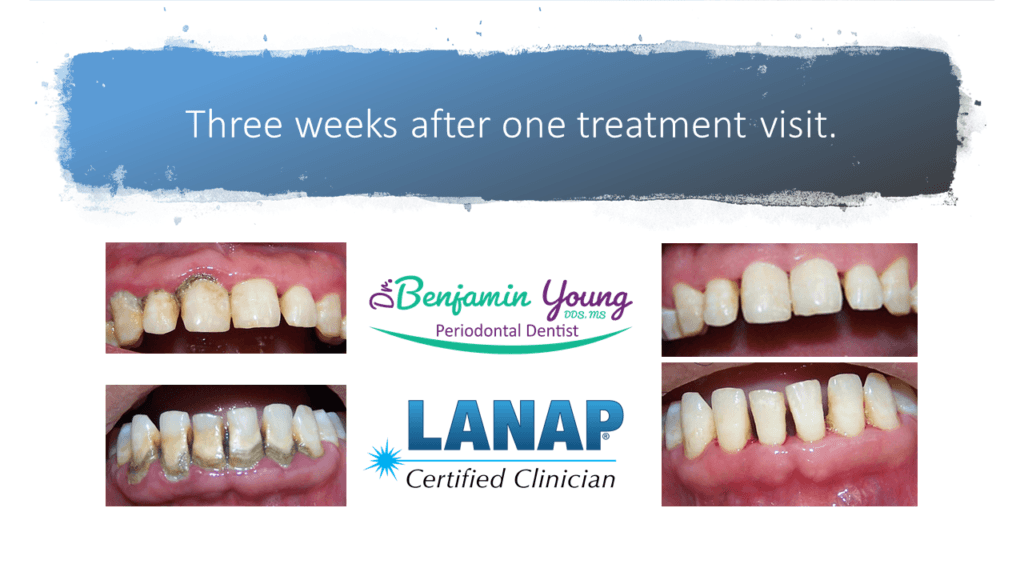
LANAP is one of the best ways to treat gum disease today because it can target the problem without hurting or removing healthy gum tissue. It can slow down or stop gum loss and make pockets in the gums smaller. The best part is that it helps the body heal from deep infections without needing a scalpel or stitches.
For over three years, I tried to get insurance companies to pay for a new laser treatment, but they usually said no. Some said lasers were “experimental,” but that’s not true. The government actually approved this treatment called LANAP because it’s safe and effective.
The government is slow and has a lot of rules, so it takes a long time to study new treatments. This can be bad because they might miss out on new and better ways to do things.
Laser treatment isn’t experimental anymore, but some insurance companies still haven’t updated their rules. I think it’s interesting that this new treatment is faster, cheaper, and can make people healthier. Maybe insurance companies think that more people would choose this new treatment instead of the old one, so they’ll have to pay more money. Insurance companies like it when treatments are hard and take a long time because people might not do them, so the insurance company doesn’t have to pay.
Periodontal disease is one of the leading causes of tooth loss, but treatment does not always require traditional surgery. Our practice focuses on minimally invasive periodontal care designed to treat moderate to advanced gum disease with less discomfort, reduced bleeding, and faster recovery.
We utilize advanced laser periodontal therapy, including LANAP® protocol treatment, to target infection while preserving healthy tissue whenever possible. Patients often experience a more comfortable recovery and are able to return to normal activities much sooner than with conventional gum surgery.
LANAP® (Laser-Assisted New Attachment Procedure) is FDA-cleared and supported by clinical research demonstrating its safety and effectiveness in the treatment of periodontal disease. Yet despite this, no dental insurance carriers currently provide true coverage for LANAP as a distinct laser periodontal procedure because there is no dedicated ADA CDT code that recognizes LANAP itself.
Some insurance companies will reimburse portions of treatment using conventional periodontal surgery codes such as flap surgery or osseous surgery. However, this is not true LANAP coverage. When an insurance carrier substitutes a traditional surgical code in place of a laser procedure, they are covering only the conventional surgical equivalent—not the LANAP protocol, the laser technology, or the unique clinical approach itself.
This distinction matters. If there is no recognized laser CDT code and reimbursement occurs only through an alternate benefit provision, then the laser aspect of the patient’s care is not actually covered.
Our goal is simple: help patients regain healthy gums, preserve natural teeth whenever possible, and improve long-term oral and overall health.
Now for the good news: my fees are among the lowest of any board-certified periodontist because my goal is simple—to help as many people as possible recover rapidly from moderate to advanced chronic periodontitis with the least discomfort and the best possible long-term outcome.
FAQs
1. Conventional Care. The first phase is non-surgical therapy. This is scaling and root planing and involves the scaling off of tartar or calculus and then the smoothing of the root surface. The anticipated pocket depth improvement is within the range of 2 mm. LANAP is a completely different approach to therapy and is generally not Dr. Young’s approach to treating this disease. There are exceptions based on certain circumstances, but when LANAP is a viable option, it is Dr. Young’s preferred method of care for all the reasons described here. The second phase is surgical therapy. This can involve a number of different procedures depending on the specific problems of a particular area.
Conventional Care works but in general requires more appointments compared with LANAP. However, LANAP may not be enough either in specific areas and so surgical therapy involving exposing bony defects and suturing may be necessary.
2. No treatment. This is a poor choice and problems once begun can progress over time.
This is a difficult question to answer outright because we need to first know what specific problems are. Usually the cost for a comprehensive examination without any insurance coverage is under $200. But let’s put this in perspective. If someone has avoided dental care for a period of time, how much money would they have spent had they simply seen a dentists annually for check ups and periodically, as recommended , for cleanings? Think about this money now being used for the treatment of conditions now. Also, the earlier problems are addressed, the less expensive treatment will be. Personally, I would rather know specifically what things will cost rather than speculate. If you want to know more and you have dental insurance, there is probably a fee schedule you can access to see costs of periodontal care.
You live at a time in world history where we have local anesthetics and methods to help people manage their fears that are simple and predictable. Also the level of tenderness following procedures in this area of dentistry are effectively managed without the need for narcotic pain medications. So, no. Treatment should not be painful.
Your initial visit will be about an hour of your time. During that visit we will provide you with a full periodontal exam, diagnosis, and treatment plan. Following this, especially if we will be using laser gum disease treatment, it will take as few as two additional appointments and no more than an additional four hours of time before you are back to seeing your general dentist and dental hygienist for continuing supportive periodontal care going forward. If you have not watched my explanation about managing periodontal disease I recommend you do so.
Watch “A Tooth Has Four Parts” to find out. It will take fifteen minutes of your time.