

Dental Implants
What is a Dental Implant?
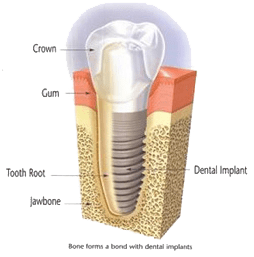
A dental implant is an artificial replacement for a natural tooth root. A titanium post is inserted into the jawbone to act as a replacement root. A connecting piece known as an abutment is placed on top of the implant and functions as the attachment point for a dental crown, a bridge, or a denture.
Building a strong foundation
The implant fuses (integrates) with your jawbone and securely anchors the implant in the jaw. The integrated implant is as strong, or even stronger than a natural tooth root.
Successful dental implant treatment depends on precision. Our practice uses advanced digital imaging and guided implant planning technology to place implants with exceptional accuracy and safety.
Three-dimensional CBCT imaging allows us to evaluate bone anatomy, nerve position, sinus location, and restorative goals before treatment begins. Using digital surgical planning, implants can often be positioned more precisely, reducing unnecessary trauma and improving both functional and cosmetic outcomes.
This state-of-the-art approach helps create:
- More predictable implant placement
- Improved long-term stability
- Better esthetic outcomes
- Reduced surgical risk
- Greater patient comfort during recovery
Our commitment to modern technology and careful planning allows patients to receive implant care that is efficient, precise, and designed for long-term success.
Dental implant benefits
Dental implants allow you to talk, chew and exert pressure just like natural teeth.
Dental implants don’t require the grinding down and weakening of adjacent teeth, as with dental bridges.
Dental implants are the most long-lasting of all tooth replacement options, and if cared for properly they can last a lifetime.
With dental implants, you can bite and chew the foods you need for proper nutrition and do not have to use a blender.
Dental implants fill the gap left by the missing tooth and help prevent bacteria from accumulating on adjacent teeth, thus helping to prevent periodontal disease.
Dental implants have the same biting and chewing power as natural teeth. This pressure is needed to maintain the bone volume around the implant and the adjacent teeth. Without this pressure, jaw bone tends to shrink and your face can get a “collapsed” look.
Comfortable Full-Arch Implant Solutions
When teeth are failing because of advanced periodontal disease, extensive tooth decay, or tooth loss, patients often feel overwhelmed, frustrated, and uncertain about their future dental health. Eating becomes more difficult, appearance may change, and many patients lose confidence in their smile and overall quality of life.
Our practice focuses on helping patients transition efficiently and comfortably from failing teeth to stable, natural-looking implant-supported solutions designed to restore health, function, and confidence.
Using careful treatment planning, advanced surgical techniques, and modern implant technology, we strive to simplify what can otherwise feel like a complicated process. Our goal is to minimize discomfort, reduce treatment time whenever possible, and help patients regain confidence in their smile and ability to eat comfortably.
Whether replacing a single tooth or rebuilding an entire arch, treatment is tailored to each patient’s needs with an emphasis on comfort, function, health, and long-term stability.
Patients appreciate having a clear plan, experienced surgical care, and a practice focused on making complex treatment feel manageable, comfortable, and predictable.
Disadvantages of dentures
The jawbone supporting your teeth needs biting and chewing pressure on your tooth roots to maintain its volume and density. When your teeth are lost, this pressure is no longer provided, and your jawbone gradually dissolves away and sinks. When you have lost all your teeth, the entire ridge of your jaw loses height and thickness and causes the lower third of your face to have a collapsed look.
Dentures alone do not provide the biting and chewing pressure necessary to maintain the bone volume in your jaw. The type of pressure placed on the jaw by dentures actually accelerates bone loss and facial collapse, which is why denture wearers often look prematurely aged.
Dentures slip and have to be routinely refitted due to jawbone shrinkage.
Dentures can make noise or click while you are talking or eating.
Dentures often need to be secured in place with adhesives.
Dentures cover the roof of your mouth and inhibit your sense of taste.
Dentures provide only 10% of the biting and chewing power of natural teeth, making it difficult or impossible to chew many of the foods you need for good health and necessitating the use of a blender if you eat these foods at all.
Who are candidates for Dental Implants?
Due to major advances in technology, most people can now successfully receive dental implants. In the past, people with too much missing bone around their teeth could not receive implants as the implants would be inadequately supported. Dr. Young can regenerate the lost bone through advanced bone grafting procedures and provide the needed bone support for implants to be stably placed.
Even patients with health problems that formerly made implant placement too risky can now receive dental implants. Dr. Young can work directly with your physician as needed to ensure your treatment is a success.
Except for young persons whose jaw structures have not developed fully, there are no age limits on who can receive dental implants.